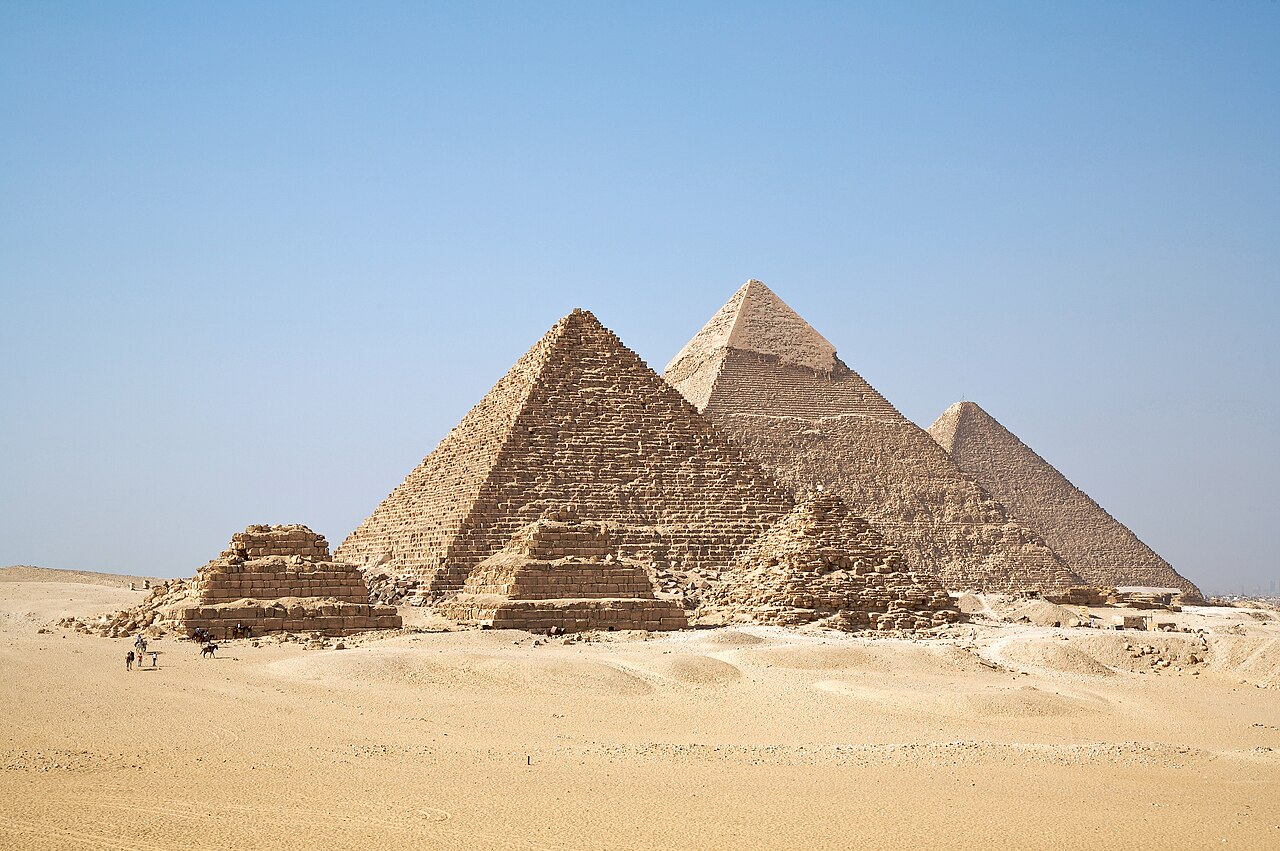
A photograph of the Great Pyramid gives the impression of something completely known: an unmistakable outline, a famous entrance, familiar chambers. The stone hides much more than the outline reveals. In 2017 an international team announced a large internal void above the Grand Gallery. They had detected it without opening a new passage through the masonry.
The clue arrived from the sky. Cosmic-ray interactions produce muons, particles that can pass through substantial thicknesses of stone. Count enough of them from enough directions and differences in density become visible. A region transmitting more particles than expected can betray a space that the eye cannot see. The pyramid was being examined with a natural particle probe.
A signal earns a second look
The ScanPyramids Big Void was first detected using nuclear-emulsion films inside the Queen’s Chamber. The discovery did not rest on that instrument alone. Scintillator detectors in the same chamber and gas detectors outside the pyramid independently supported it. Different equipment and viewpoints turned an unexpected signal into a finding that could survive a serious cross-check.
The 2017 paper reported a minimum length of 30 metres and a position above the Grand Gallery. It deliberately left the intended purpose unresolved. The finding was a density measurement, not a photograph of furnishings. Calling it a treasury, a burial chamber or evidence of unknown builders would add a story that the particles had not supplied.
Another space, another investigation
Near the north face, a separate anomaly lay behind the great angled stone beams known as chevrons. Investigators followed it through further measurements. In 2023 a paper characterised the North Face Corridor as roughly nine metres long, with a cross-section around two metres by two metres. This was a distinct feature, not a close-up of the Big Void.
The distinction matters because the two discoveries are easily merged into one sensational chamber. The corridor was close enough to the surface for additional investigation. The ScanPyramids researchers used several detector positions and compared the observations with simulations containing the known architecture. Shape and location became more constrained, while the architectural meaning remained a question.
When the measurement meets the camera
Researchers from Cairo University and the Technical University of Munich also examined the north-face masonry with ground-penetrating radar and ultrasound. Those techniques contributed a different kind of evidence, confirming an air anomaly behind the chevrons. Matching results across methods helped identify where a very small route for inspection could be considered.
CEA’s March 2023 account describes an ultrathin endoscope passed between stone joints. The corridor could finally be seen rather than inferred only from particle counts. That progression is the remarkable part: a predicted absence inside solid-looking architecture became a visible space. The camera confirmed the corridor; it did not answer the separate Big Void’s purpose.
Now follow the evidence.
THE EVIDENCE / SOURCE BY SOURCEOpen the evidence.The claims, what the record supports, and what remains open.
SOURCE REVIEW / 9 October 2026
Hidden architecture is established
Two distinct internal features are supported by modern measurements. The North Face Corridor was also inspected by endoscope. The discoveries demonstrate that important architectural questions remain inside the Great Pyramid; they provide no evidence here for treasure, extraterrestrial builders or a concealed advanced civilisation.
A large void lies above the Grand Gallery.
Three detector technologies supported the 2017 result.
The 2023 corridor is the same feature.
The north-face structure and Big Void occupy different locations.
The corridor was visually inspected.
The research team reports endoscopic observation.
The Big Void’s contents and function are known.
Density measurements do not establish either conclusion.
The next question.
The next architectural question is more difficult than the discovery headline. Was a space intended to relieve loads, aid construction or serve some other purpose? Each explanation must fit its dimensions, position and relationship to the surrounding stonework. An attractive theory that cannot fit the measured geometry would explain very little.
The mystery survives because the monument is real and access is limited. More viewpoints can sharpen an internal outline, while carefully approved investigations may add direct observations. Any proposed intervention also has to preserve the structure that makes the question possible. The gap in knowledge is a research problem with measurable boundaries, rather than an invitation to fill the space with anything imaginable.
Read the record
for yourself.
These are the documents, objects and studies behind this story. Their findings and limits belong to the named source.
- 01
ScanPyramids: original 2017 Big Void paper
Original discovery, including detector cross-checks, minimum length and explicitly unresolved purpose.
- 02
CEA: the three muography systems
First-party detector team account of independent measurements and density imaging.
- 03
Original 2023 North Face Corridor study
Original muon characterisation of the separate corridor’s geometry and location.
- 04
Cairo and TUM: radar and ultrasound study
Research-team publication record explains the complementary non-destructive measurements.
- 05
CEA: from muography to endoscopic images
First-party March 2023 account of confirmation and the ultrathin endoscope.
- 06
Giza photograph: author and source
Ricardo Liberato; retouching by Ikiwaner. Image credit only, not evidence of internal features.
- 07
Photograph licence: CC BY-SA 2.0
Applies to the Giza photograph and any adapted image version, not this original narrative.