Ancient Egyptian artisans hollowed and polished vessels from demanding stones. The pictured diorite jar is catalogued by The Met as Early Dynastic, around 3100–2650 BCE. Its material and compact form invite a close look at the work required. Archaeological drill cores, unfinished vessels, tool traces and experiments provide evidence for drilling and abrasive techniques. Denys Stocks tested early vessel-making methods; research at The Met identified a corundum-rich abrasive in a later Amarna drill hole. Exact processes and measured tolerances for particular objects remain questions worth investigating. Extraordinary craftsmanship is already established.
A 2025 study compared scans of 19 Petrie Museum vessels with 49 modern vessels. Ancient interiors showed strong circularity but weaker concentricity, patterns the author interpreted as consistent with rotational grinding. Overall quality overlapped handmade comparators. The pictured Met jar was not measured.
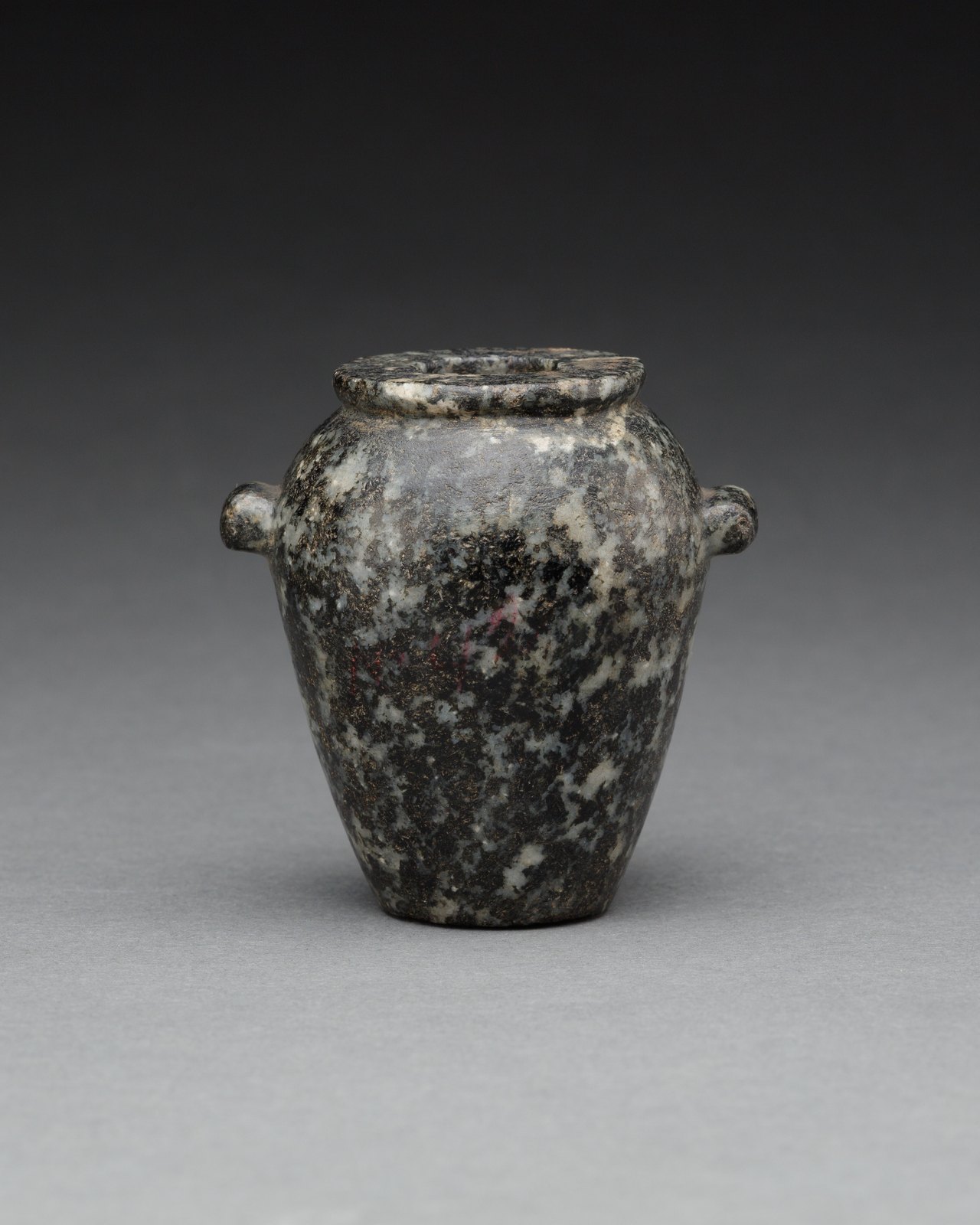
Start with an individual object. Which museum accession, which stone, what date, and what measurements? A photograph can show exquisite craftsmanship while concealing asymmetry, repair, wear and the interior surface. The Met jar here is a real, very small object. It should not silently stand in for every unprovenanced vessel circulating in precision claims.
Circularity asks how close one section is to a circle. Concentricity asks whether different sections share a centre. Smoothness, wall thickness and dimensional tolerances ask other questions again. A vessel can score well on one measure and less well on another. A comparison score is not an engineering tolerance in micrometres.
The 2025 study’s comparison with handmade modern vessels is especially useful because it supplies a reference population. The reported geometry was interpreted as consistent with rotational grinding. It does not measure the pictured Met jar, and it does not establish that an ancient object could not be reproduced using current technology.
Workshop remains help connect finished objects to work: cores, unfinished vessels, abrasive residues and marks. Experimental archaeology tests whether a proposed process can achieve a task with plausible materials. Successful replication demonstrates a possibility; it does not by itself identify the exact sequence used by every ancient artisan.
The established record.
- 01
The pictured jar is diorite and only 5.7 cm high.
- 02
Ancient workshop finds include drill cores and unfinished vessels.
- 03
Experimental archaeology tests drilling with historically plausible materials.
How the story unfolded.
- Early Dynastic period
The pictured jar is made
The Met dates its diorite jar to about 3100–2650 BCE.
- 1993
Manufacturing is tested experimentally
Denys Stocks publishes work on early vessel-making methods.
- 16 December 2025
A measured comparison
A study compares 19 Petrie Museum vessels with 49 modern vessels.
Where the evidence stops.
The sources do not establish that these vessels are impossible to reproduce today. Comparative geometry scores are not engineering tolerances. Proposed precision must be measured on authenticated objects; later abrasive evidence cannot automatically explain every earlier vessel.
Read the original sources.
The source may establish a narrower point than the headline. Follow the specific finding, its date and its limitations.
What would a securely provenanced object, a full scan and a reproducible manufacturing trial establish together?