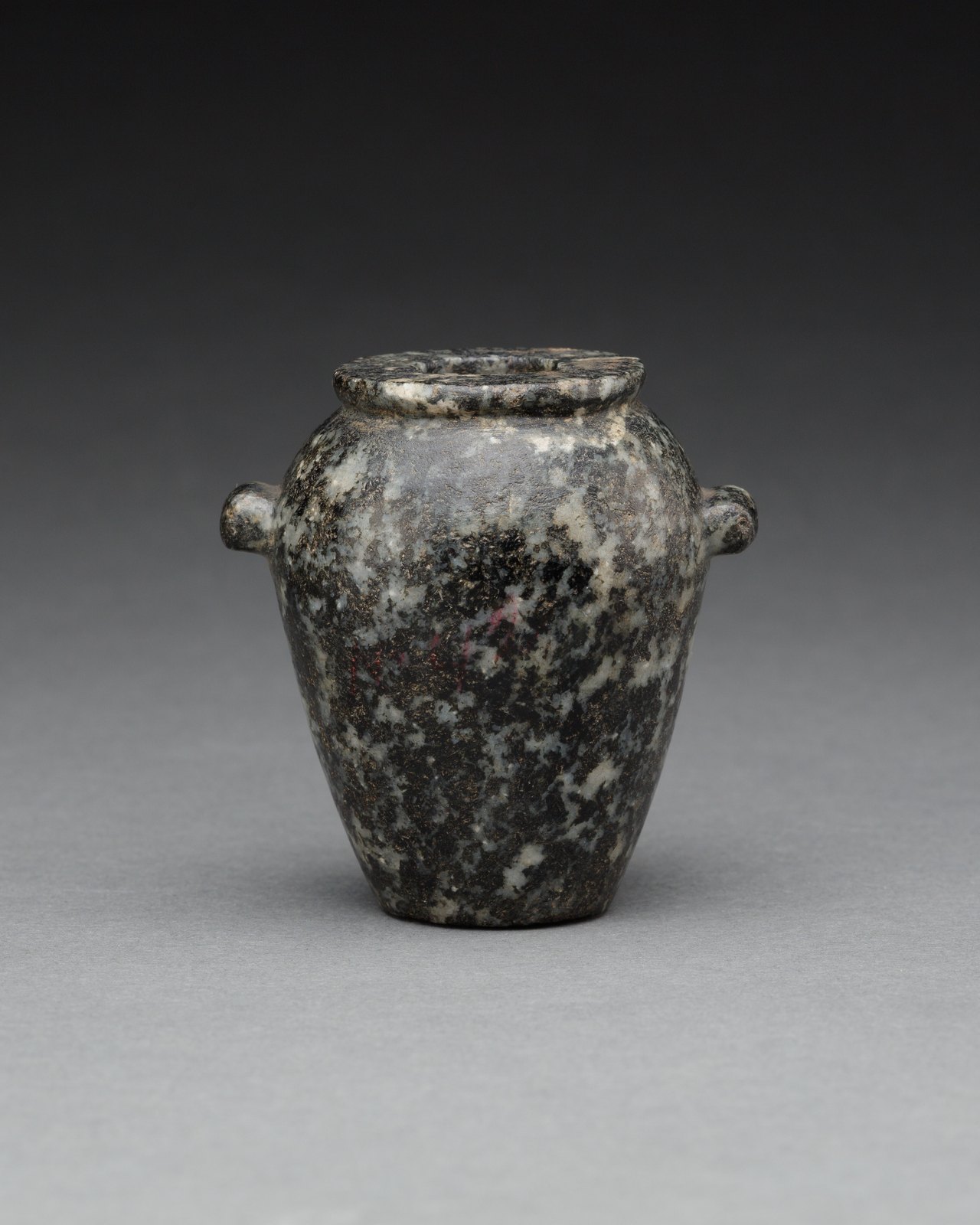
At first it looks like a small container. Then the material changes the picture. The Metropolitan Museum of Art catalogues this jar as diorite, made around 3100–2650 BCE. It stands only 5.7 centimetres high. Its opening invites an awkward question: how do you hollow hard stone through a mouth much smaller than the body?
Ben van Kerkwyk’s UnchartedX brings modern metrology to that ancient puzzle: scan the vessels, inspect their curves and ask whether their precision points to lost advanced machining. He argues that it does. Testing that interpretation means looking beyond a photograph. What would the stone have to preserve for the measurements to identify its makers’ tools?
The surface becomes a dataset
In its 2023 account, UnchartedX described laboratory inspection alongside structured-light and CT scanning of several vessels. This is a productive move away from judging a polished photograph: a scan can expose uneven walls, changing centres and differences between inner and outer surfaces. Those features can become measurements that other investigators can question or repeat.
But geometry does not supply an excavation history. The same post corrected an ownership detail for one large vessel; a 2025 update described scans from the Petrie Museum. Private collections and museum collections require object-specific documentation. An impressive scan is evidence about the scanned shape. Its archaeological age, material history and manufacturing interpretation need additional evidence.
A comparison changes the question
Looking down a narrow opening, the eye supplies a deceptively simple test: does the interior look smooth? A scan asks harder questions. How round is each cross-section? Do the centres of successive sections line up? Could a series of individually impressive circles still describe a cavity that wanders slightly through the stone?
Now consider the mouth. Can the chosen instrument see every internal surface, or does the opening conceal parts of it? Which regions were measured, and which were reconstructed? A December 2025 study compared 19 Petrie Museum vessels with 49 modern examples. Its assessment turns on these distinctions: geometry, uncertainty and the difference between a measured shape and an intended dimension.
What abrasive work leaves behind
Experimental archaeologist Denys Stocks investigated early vessel drilling by testing materials and techniques. Experiments matter because they turn an explanation into work that produces a hole, debris and tool wear. They can show that a proposed process is feasible and help identify its traces. Reconstructing one process does not automatically reproduce every vessel or establish one universal method. Matching a polished shape is only part of that comparison; the work itself must leave comparable evidence.
Another clue survives in an Amarna stone fragment examined by Met researchers Anna Serotta and Federico Carò. A drill-hole residue contained corundum-rich abrasive and bronze corrosion products. The abrasive helps explain how a relatively soft metal tool could work demanding stone. This is later New Kingdom evidence, so it cannot simply be transferred to every Predynastic object.
Now follow the evidence.
THE EVIDENCE / SOURCE BY SOURCEOpen the evidence.The claims, what the record supports, and what remains open.
SOURCE REVIEW / 9 October 2026
The craftsmanship survives the argument
The 2025 Petrie sample’s overall geometry overlapped modern handmade comparators. Its interiors combined strong circularity with weaker concentricity, interpreted by the author as consistent with rotational grinding and tool repositioning. These are relative quality scores, not engineering tolerances. The pictured Met jar was not measured. The cited evidence does not demonstrate necessary lost advanced machining or impossibility of modern reproduction.
Egyptian artisans made vessels from demanding stone.
Museum objects and experimental research establish the material problem.
The Petrie sample proves modern machine-level precision throughout.
Overall scores overlapped handmade comparators; inner circularity was a distinct result.
A precise scan dates a privately owned vessel.
Geometry alone does not establish archaeological provenance or antiquity.
Lost advanced machining is required.
That interpretation has not been demonstrated by the cited evidence.
The next question.
The interesting unfinished work is now specific. Which marks remain beneath the polish? Can an experimentally made interior reproduce the same distribution of circularity and displaced centres? A persuasive answer would connect an authenticated object, a documented measurement procedure and a process that leaves matching physical traces.
There is room to investigate exceptional individual vessels without turning a class average into a verdict on every object. There is also room to admire the pictured jar without attaching somebody else’s tolerance claim to it. Its small scale concentrates the achievement: a patterned, stubborn material made into a controlled and delicate form.
Read the record
for yourself.
These are the documents, objects and studies behind this story. Their findings and limits belong to the named source.
- 01
The Met: diorite jar 2021.41.59
Object catalogue supplies its material, assigned date, dimensions and public-domain image. This jar has no precision claim here.
- 02
UnchartedX: the 2023 vase measurement programme
The named proponent’s own account, including methods, interpretation and a provenance correction; not independent verification of every inference.
- 03
UnchartedX: provenance and Petrie Museum scanning
First-party April 2025 update establishes that its discussion includes museum scanning as well as private collections.
- 04
Published 2025 comparative vessel metrology
Original study, 16 December 2025. Relative geometry and proposed manufacturing processes require separate interpretation.
- 05
Stocks: experimental stone-vessel manufacture
Original 1993 experimental archaeology paper; publisher abstract is accessible, full text may require access.
- 06
The Met: drill-hole abrasive analysis
First-party researcher account of the later Amarna fragment, with material analysis and its limits.