A lump of corroded bronze from a shipwreck can conceal an astonishing amount of information. The Antikythera mechanism reached the National Archaeological Museum during salvage in 1900–1901. What survived was fragmentary and difficult to read. Inside it were gear teeth: the remains of an ancient machine built to represent celestial cycles.
The museum places its creation around 150–100 BCE. Its date makes the surviving engineering remarkable, but the object also belongs to a world with astronomical observations, mathematics and mechanical devices. The mystery is how that knowledge was assembled into this particular instrument, and how much of its original arrangement can still be recovered.
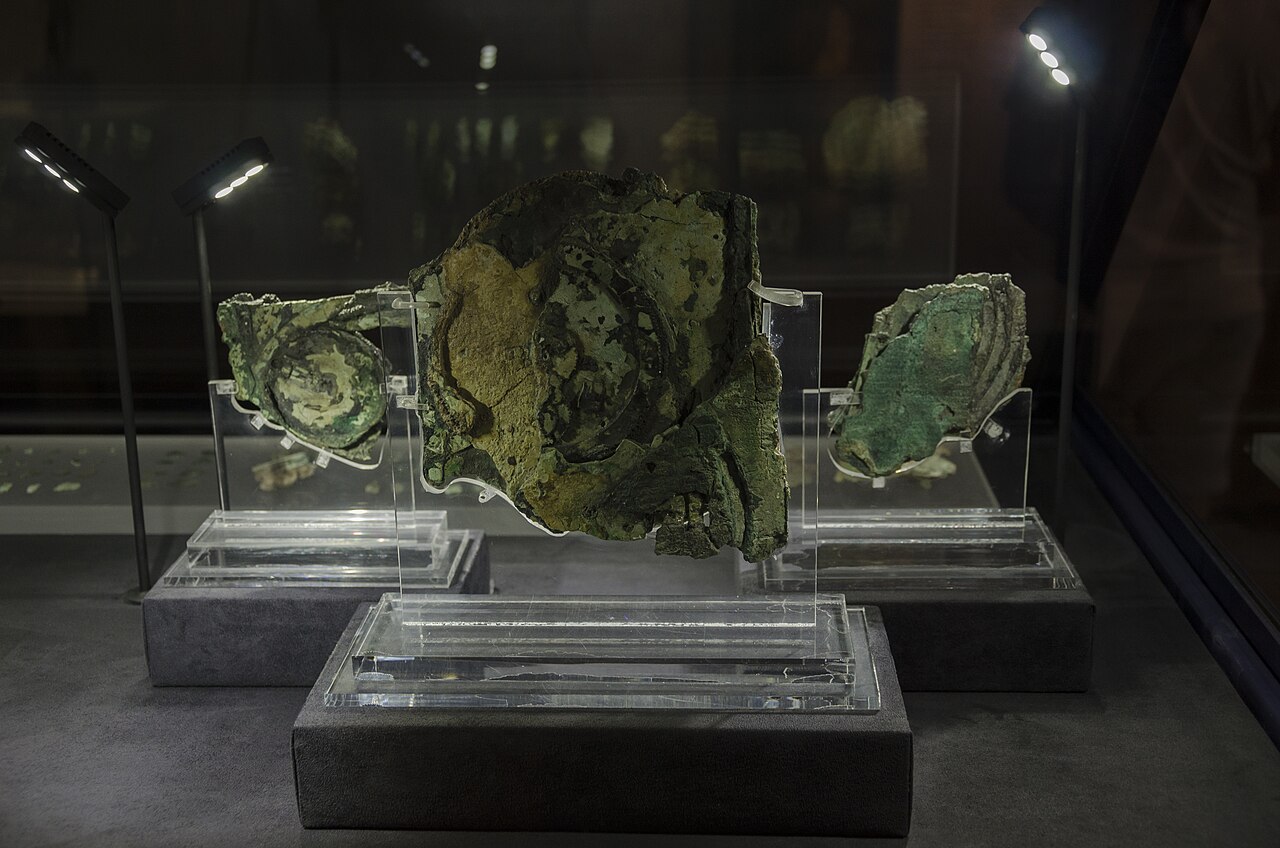
Seeing through the corrosion
The mechanism has been studied through successive generations of imaging. Early researchers offered different interpretations; later X-rays and tomography provided more detail. In 2006, a research team reported high-resolution X-ray tomography and surface imaging that clarified gear functions and doubled the number of deciphered inscriptions. What looked inaccessible became a source of readable mechanical evidence.
Those inscriptions matter as much as the gears. They describe functions and displays, helping constrain what a reconstruction must do. A clever modern model could calculate many things; the difficult task is finding a model that fits the surviving components and text. Each fragment supplies restrictions as well as possibilities.
A cycle becomes a prediction
One of the strongest findings is an eclipse system built around the Saros cycle of 223 lunar months. Tony Freeth’s research explains how marks distributed along a spiral dial represented eclipse possibilities. The device translated a long astronomical cycle into a physical scale that a user could consult, with inscriptions adding information about the predicted events.
That is already an extraordinary act of compression. A cycle extending over years becomes a relationship between gear teeth, a pointer and a labelled dial. It should not be mistaken for a flawless forecast of every eclipse visible from any location. The predictive scheme was constructed from ancient astronomical knowledge, and researchers still debate details of its reconstruction.
Rebuilding the missing front
Only about a third of the original mechanism survives. A 2021 study proposed a reconstruction of its front display that combined the remaining evidence with inscriptions concerning the Sun, Moon and five planets known in antiquity. Its authors set out a model designed to satisfy multiple constraints, rather than simply adding whatever gearing would look impressive.
A reconstruction is a reasoned answer to incomplete evidence. It is not the recovery of missing original gears. The same paper notes how earlier models differed and how new readings forced changes. The mechanism’s sophistication is established by surviving hardware; the exact arrangement of every absent component belongs to an investigation that remains open.
Now follow the evidence.
THE EVIDENCE / SOURCE BY SOURCEOpen the evidence.The claims, what the record supports, and what remains open.
SOURCE REVIEW / 9 October 2026
An ancient astronomical calculator is established
Surviving gears, imaging and inscriptions demonstrate a sophisticated mechanical instrument for celestial and calendar cycles. Some functions are well supported; missing parts leave aspects of the design unsettled. Calling it an analogue computer describes its calculating function, without implying electronics or technology detached from its ancient setting.
The object contains ancient bronze gearing.
The fragments and museum research establish the mechanism.
It represented eclipse possibilities.
A 223-month Saros dial and inscriptions support that function.
A published model recovers every original component.
Much of the instrument is missing; reconstruction remains inferential.
Its maker and full manufacturing history are settled.
The cited research does not establish a complete workshop history.
The next question.
The lost technology here is a specific machine and the full tradition that produced it, rather than evidence of an otherwise invisible modern industry. A remarkable survivor cannot tell researchers how common such instruments were. Nor does the absence of a complete second example prove that this one appeared without predecessors.
There is still a powerful story in the gap. Somebody converted observations of the sky into a compact mechanical arrangement that outlived its owner, its voyage and centuries underwater. Recovering that arrangement requires the patient comparison of teeth, holes and almost unreadable letters. The achievement grows more intelligible as the evidence improves, while the identity of its makers remains tantalising.
Read the record
for yourself.
These are the documents, objects and studies behind this story. Their findings and limits belong to the named source.
- 01
National Archaeological Museum: mechanism history
First-party museum timeline, dating and account of successive investigations.
- 02
Original 2006 tomography and inscriptions paper
Original research abstract, doi:10.1038/nature05357, explains imaging, gearing and newly deciphered text.
- 03
Freeth: the eclipse prediction scheme
Original 2019 analysis distinguishes eclipse possibilities from an unrestricted perfect prediction.
- 04
Original 2021 model of the front display
Research reconstruction addressing inscriptions and fragmentary evidence; it is a proposed model, not a recovered complete machine.
- 05
Mechanism photograph: author and source
Peulle (Petter Ulleland), 2017. Image credit; actual displayed fragments.
- 06
Photograph licence: CC BY-SA 4.0
Applies to the mechanism photograph and any adapted image version, not this original narrative.