The CIA funded secret research into drugs and behavioral modification. Surviving records and testimony document LSD administered to unwitting people, including experiments at safe houses in New York and San Francisco. Some institutions and researchers did not know the CIA was sponsoring their work.
The programme became publicly known during investigations in 1975. A 1977 Senate hearing examined records discovered after many files had been destroyed in 1973. The evidence establishes covert human experimentation and serious violations of consent. It does not establish a reliable technique for remotely controlling anyone’s mind.
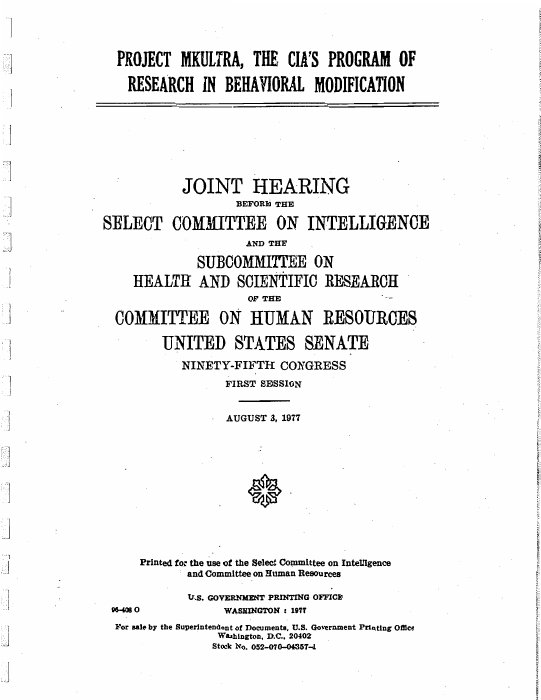
The disturbing part of MKULTRA is not a machine capable of rewriting a person. It is the decision to treat people as experimental material while hiding who paid for the work. Funding intermediaries and institutional research made the programme harder to recognise from the outside. Consent, sponsorship and accountability were different layers of the same concealment.
The surviving archive is incomplete. Records destroyed in 1973 left investigators dependent on testimony and the material recovered later. Missing files limit reconstruction; they do not justify inserting any desired story into the gaps. Read the hearing as a record of what officials acknowledged, what witnesses remembered and what investigators could still substantiate.
The established record.
- 01
Senate testimony confirmed LSD tests on unwitting people.
- 02
Safe-house experiments took place in New York and San Francisco.
- 03
Newly recovered records were examined on 3 August 1977.
How the story unfolded.
- 1953
A covert research programme
MKULTRA begins under CIA sponsorship.
- 1973
The archive is damaged
Many programme records are destroyed.
- 1977
Surviving records reach the Senate
A joint hearing examines newly recovered material and testimony.
Where the evidence stops.
Destroyed files leave gaps. Behavioral-control research does not prove successful universal or remote mind control.
Read the original sources.
The source may establish a narrower point than the headline. Follow the specific finding, its date and its limitations.
How can consent survive when even the sponsor of an experiment is concealed?